

Download Patient Referral Form >
If you've tried two or more antidepressants without finding real relief, you're not alone — and you're not out of options. SPRAVATO (esketamine) is a prescription nasal spray that targets depression differently than anything you've tried before. Used together with an oral antidepressant, it has been shown to help adults with treatment-resistant depression feel better, often within the first week or two of starting treatment.
At Charak Center, SPRAVATO is administered in a calm, supervised setting by clinicians who specialize in treatment-resistant depression. Every session is guided, monitored, and built around your safety and comfort.
The First and Only of Its Kind
SPRAVATO is the first and only NMDA receptor antagonist FDA-approved — in combination with an oral antidepressant — for treatment-resistant depression in adults. Instead of working on serotonin or norepinephrine like traditional antidepressants, it acts on the brain's glutamate system, which plays a key role in mood regulation and the formation of new neural connections. It has been studied in more than 1,700 adults with treatment-resistant depression.
For many patients, the difference isn't just that SPRAVATO works — it's how quickly it works. Traditional antidepressants typically take four to eight weeks to produce a noticeable change. SPRAVATO can begin to lift symptoms within days.
.png)
**As of August 2026, SPRAVATO and TMS services are located exclusively at our Medina Office.**
Most antidepressants you may have tried — SSRIs like Lexapro or Zoloft, SNRIs like Effexor or Cymbalta — work by adjusting serotonin or norepinephrine levels over time. They can be effective, but they don't work for everyone, and they can take weeks to make a difference.
SPRAVATO works on a completely different pathway. The active ingredient, esketamine, is an NMDA receptor antagonist that influences glutamate, the most abundant neurotransmitter in the brain. Researchers believe this helps restore connections between brain cells in regions affected by depression — essentially helping the brain rewire itself in ways that support better mood regulation.
That different mechanism is why SPRAVATO can help people who haven't responded to other medications. It isn't a stronger version of what you've already tried. It's a different approach altogether.
Download Patient Referral Form >
Is SPRAVATO Right for You?
SPRAVATO may be a fit if you are an adult who:
- Has been diagnosed with major depressive disorder
- Has tried at least two oral antidepressants without adequate improvement
- Is currently taking, or willing to start, an oral antidepressant
- Can commit to attending in-clinic sessions with a ride home afterward
Our team will walk you through eligibility, insurance authorization, and what to expect before your first session.
Download Patient Referral Form >
What to Expect at Your First Session
We know walking into a new treatment can feel intimidating, especially one you may have read mixed things about online. Here's what your first SPRAVATO session at Charak Center actually looks like.
Before you arrive. You'll skip food for at least two hours and liquids for at least 30 minutes before your appointment to reduce the chance of nausea. Avoid nasal decongestants within an hour of your dose. And arrange a ride — you won't be able to drive yourself home.
Check-in and prep. When you arrive, our team will check your blood pressure and review how you've been feeling. You'll be brought to a private, comfortable treatment room.
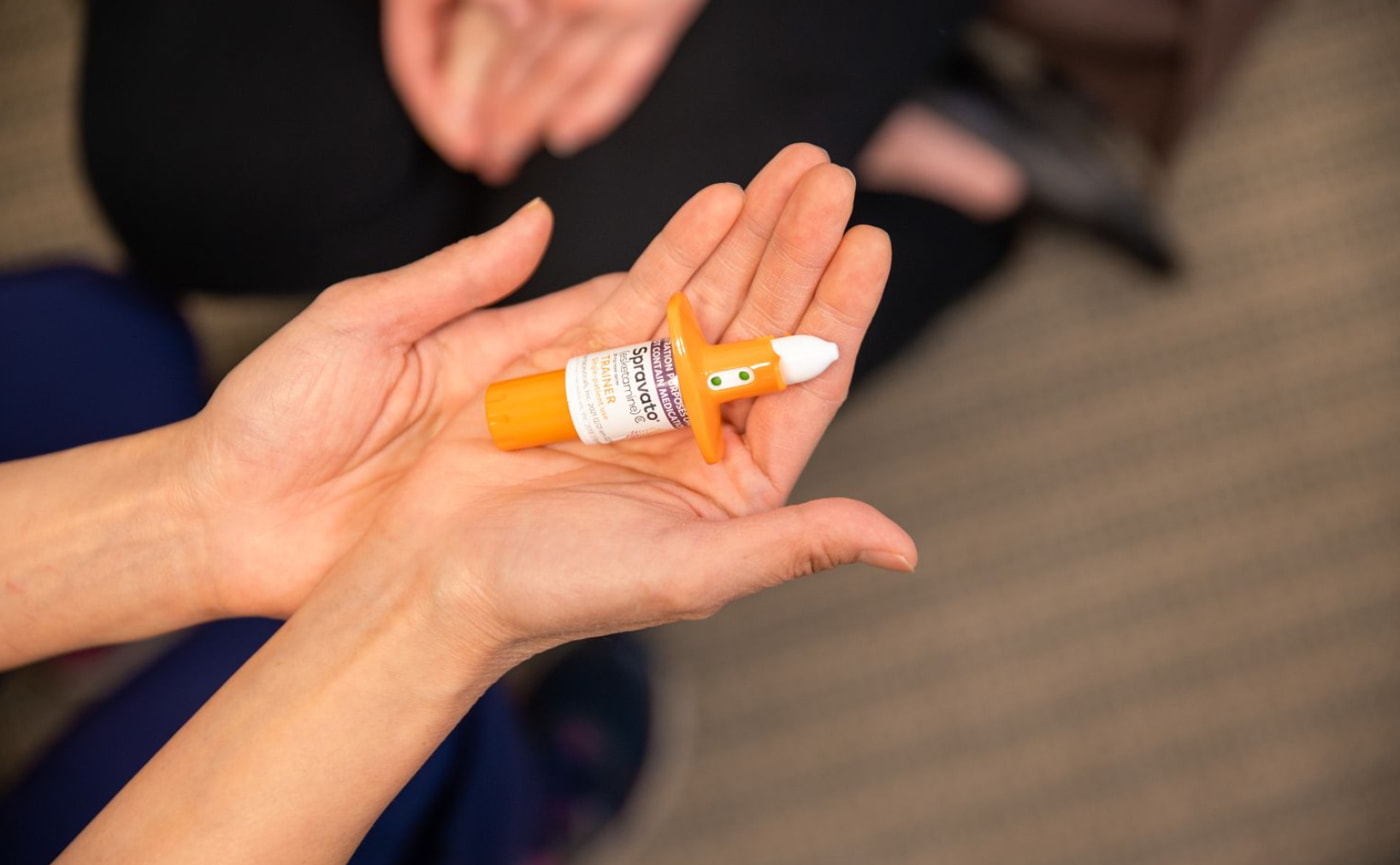
The dose itself. You'll self-administer the nasal spray under the direct supervision of a healthcare provider. Each device contains two sprays. Depending on your prescribed dose, you'll use two or three devices with short rest periods in between. The actual administration takes only a few minutes.
The next two hours. You'll stay with us in the treatment area for at least two hours. Most patients feel some level of dissociation, dizziness, or sedation during this time — this is expected and typically peaks around 40 minutes in, then gradually fades. Many patients find it helpful to rest with eyes closed and listen to calming music. We'll check your blood pressure periodically and stay close in case you need anything.
Going home. Before you leave, a clinician will assess that you're stable enough to head out. Your ride will pick you up. Most patients are advised not to make important decisions or operate machinery for the rest of the day — plan a quiet evening.
Your Treatment Schedule
SPRAVATO works best as part of a structured plan. For treatment-resistant depression, the standard protocol unfolds in three phases:
Induction phase (Weeks 1–4). Two sessions per week. This is when the medication builds its effect, and most patients begin to feel the first signs of improvement.
Stabilization phase (Weeks 5–8). One session per week, as your response is reinforced and your provider tracks your progress.
Maintenance phase (Week 9 onward). One session every one to two weeks, based on how you're doing. Many patients continue maintenance for several months or longer.
Your provider will adjust this schedule to fit your response and your life. The goal isn't just to feel better in the short term — it's to build durable improvement.
Why Charak Center
SPRAVATO can only be administered at facilities certified through the SPRAVATO REMS program, and Charak Center is proud to be one of them in Northeast Ohio. But certification is just the baseline. What sets our program apart:
Experienced psychiatric team. Our clinicians specialize in treatment-resistant depression and have guided many patients through SPRAVATO from their first hesitant question through long-term maintenance.
Comfortable, private treatment spaces. Sessions take place in calm, quiet rooms designed for the two-hour monitoring period — not a busy clinical hallway.
Insurance and authorization support. Prior authorization for SPRAVATO can be a maze. Our team handles the paperwork, advocates with your insurer, and helps you understand your coverage and copay options before you commit.
Integrated care. SPRAVATO works alongside your oral antidepressant, and often alongside therapy and other supports. Our team coordinates with your existing providers — or can connect you to ours — so your treatment is cohesive, not fragmented.
Locations across Northeast Ohio. With offices in Elyria, Garfield Heights, Mentor, Stow, Medina, and Pepper Pike, finding a convenient location for your twice-weekly induction sessions is easier than driving across the region.
For more information on SPRAVATO treatment, call our mental health clinic at 855.4CHARAK
Download Patient Referral Form >
1.SPRAVATO™ [Prescribing Information]. Titusville, NJ: Janssen Pharmaceuticals, Inc. March 2019.
2.Data on file. Janssen Pharmaceuticals, Inc. Titusville, NJ.
Indication:
SPRAVATO™ (esketamine) CIII Nasal Spray is indicated, in conjunction with an oral antidepressant (AD), for the treatment of treatment-resistant depression (TRD) in adults.
SPRAVATO™ is not approved as an anesthetic agent. The safety and effectiveness of SPRAVATO™ as an anesthetic agent have not been established.
For more information on SPRAVATO treatment, call our mental health clinic at 855.4CHARAK
Download Patient Referral Form >
How we use Creyos in our clinic
Taking a Creyos Health assessment is straightforward and hassle-free—no need for any fancy gadgets. You can do it on any device you prefer, like your laptop, desktop, or tablet, and it works with all the latest web browsers. Here's a quick run-through of the steps: Your healthcare provider set up an time for you to do the assessment. Before you take the assignment, you will be guided on what to expect, how to tackle the assessment, and how long it'll probably take. After you've got the hang of the tutorial, it's showtime! Complete the task, and once you're done, a report will zip off to your practitioner to check out.

Frequently asked questions
What is Spravato?
Spravato is the brand name for esketamine, a prescription nasal spray developed by Janssen (a Johnson & Johnson company). It's derived from ketamine and works on the brain's glutamate system, which is a different mechanism than traditional antidepressants that target serotonin or norepinephrine.
What is it used for?
Spravato is FDA-approved for two uses in adults: treatment-resistant depression (TRD), meaning major depressive disorder that hasn't responded adequately to at least two other antidepressants, and major depressive disorder with acute suicidal ideation or behavior. It is not approved as an anesthetic or as a replacement for hospitalization when hospitalization is needed, and its safety and effectiveness have not been established in children.
Do I still have to take my regular antidepressant?
Yes. Spravato is given alongside an oral antidepressant, not as a standalone treatment.
How is it administered?
You self-administer the nasal spray under direct supervision at a certified healthcare facility. Each device delivers two sprays containing a total of 28 mg of esketamine. FDA Depending on your prescribed dose (56 mg or 84 mg), you'll use two or three devices per session with short rest periods between them.